Your Farm Is Talking. Are You Listening?
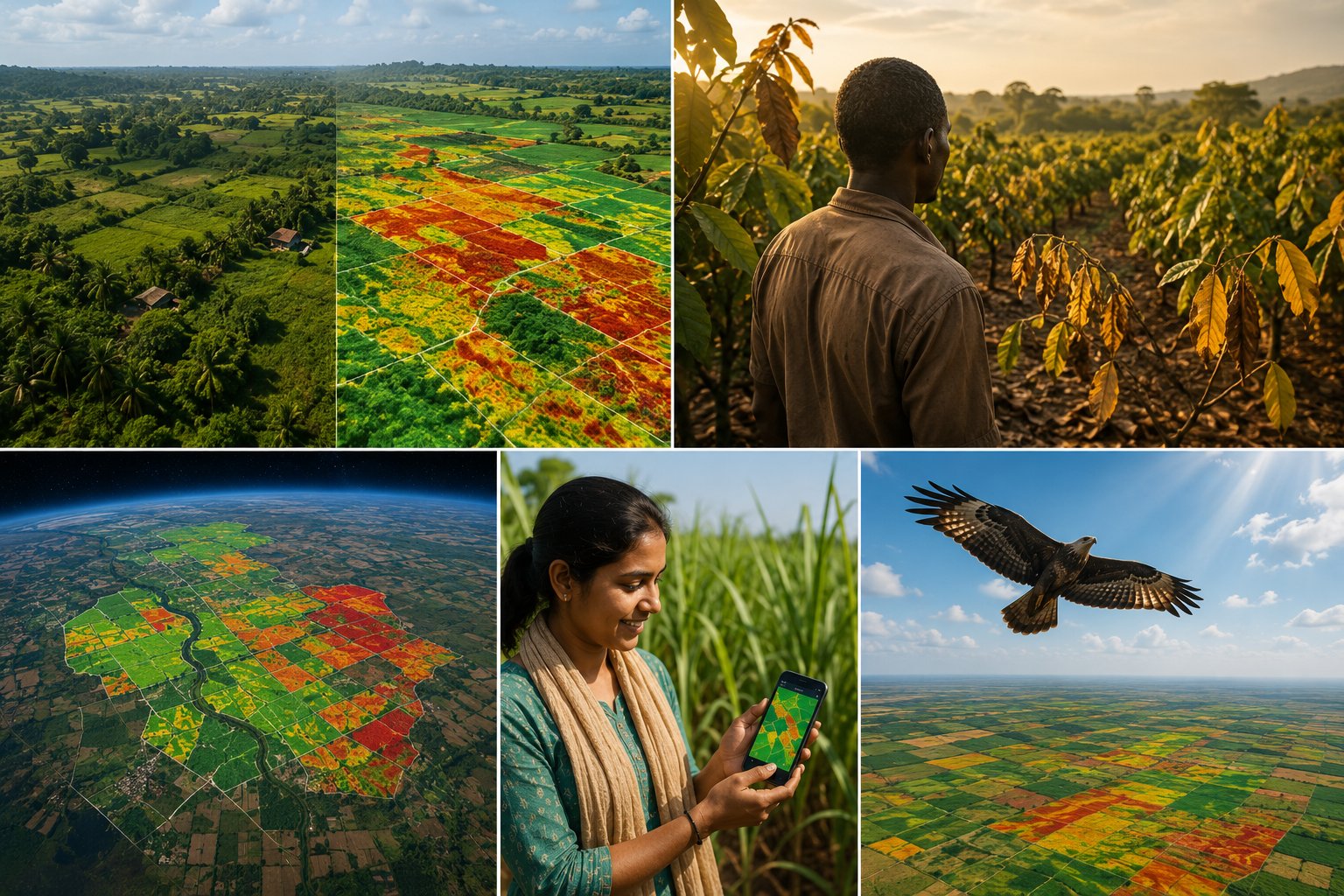
FarmHawk — What your eyes see vs what satellites reveal
Every season, millions of smallholder farmers face the same cruel math. By the time crop stress becomes visible — wilted leaves, discoloured stems, patchy growth — the damage has already been compounding beneath the surface for weeks, sometimes months.
A cocoa farmer in Ghana's Western Region shared a message with us recently that captures this problem:
"I lost 30% of my yield last season. By the time I saw the leaves turning, it was already too late."
That single sentence describes the central tragedy of smallholder farming. Not a lack of effort. Not a lack of knowledge. But a devastating lack of timing. Those lost weeks are not abstractions. They are lost income, lost food security, and for families surviving on margins thinner than most of us can imagine, they can mean the difference between a child going to school or not.
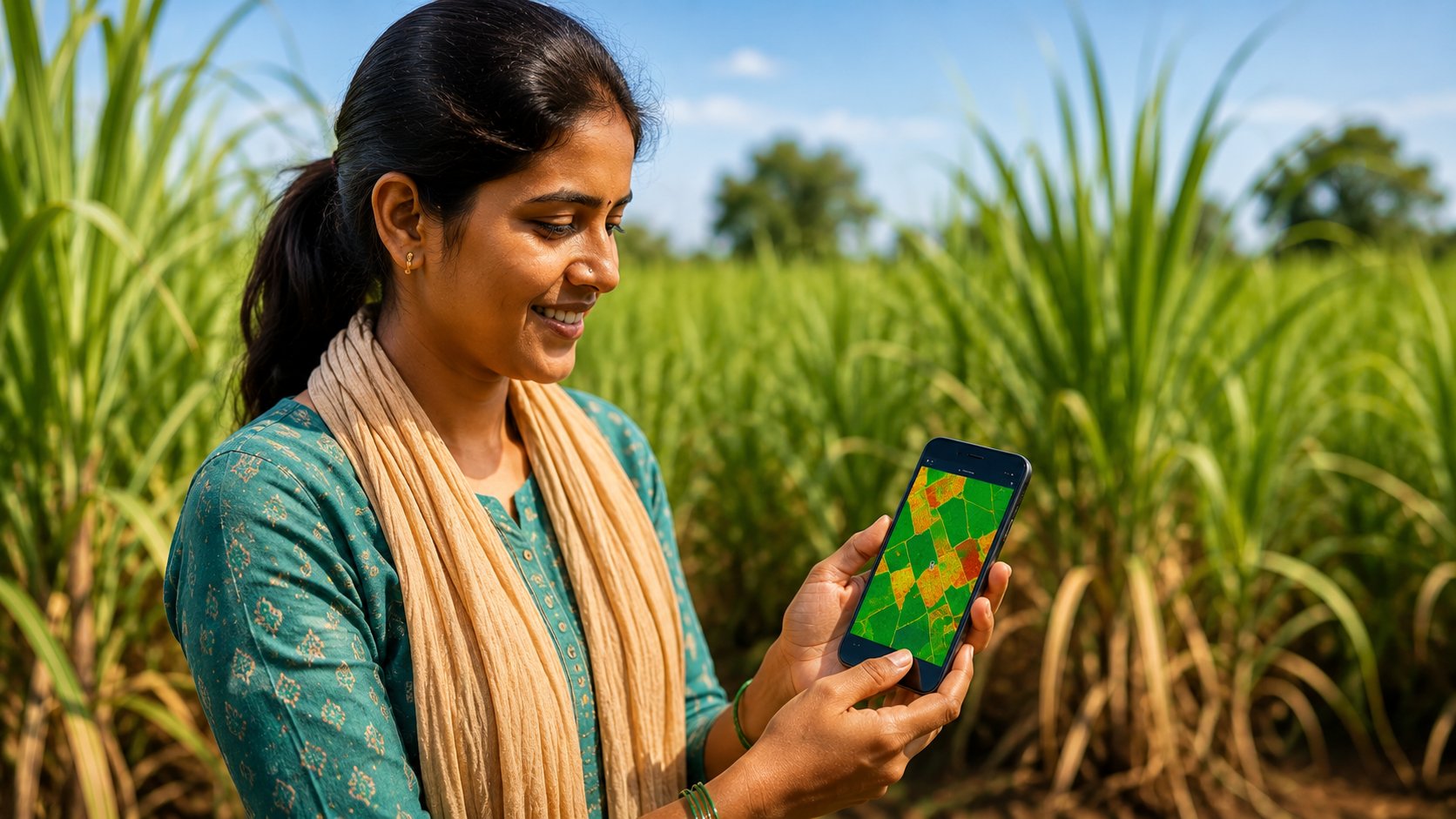
For millions of smallholder farmers, crop stress only becomes visible after the damage is already done
The Invisible Crisis Beneath the Canopy
Here is an uncomfortable fact: a farm that looks healthy today may already be failing. Moisture stress develops in the root zone long before leaves show any sign of wilting. Nutrient deficiencies alter the cellular chemistry of plant tissue days or weeks before they manifest as visible chlorosis. Pest infestations begin at a scale invisible to the naked eye, spreading through a field in patterns that no farmer walking through rows could possibly detect in time.
This is not a failure of the farmer. It is a fundamental limitation of human perception. Our eyes can detect roughly three bands of the electromagnetic spectrum — red, green, and blue. The story of crop health is written across thirteen.
Every five days, the European Space Agency's Sentinel-2 satellites pass over every farm on Earth, capturing data across 13 spectral bands — from visible light through near-infrared to short-wave infrared. Each band reveals a different dimension of plant health that remains completely invisible to human observation.
Until now, this data has flowed overwhelmingly to research institutions, government agencies, and commercial agribusiness operations — organisations with the technical resources to process satellite imagery. The 500 million smallholder farmers who grow roughly a third of the world's food have been excluded from the intelligence that could transform their livelihoods.
FarmHawk was built to close that gap.
Three Threats Every Farmer Faces — And What Satellites See First
Through our work across India, Nigeria, Kenya, and Ghana, we have identified three categories of crop threat that consistently erode smallholder income. Each is detectable through satellite spectral analysis weeks before any physical symptom appears.
1. Moisture Stress — The Silent Yield Killer
Water stress is the single largest driver of yield loss globally. A plant's water status changes at the cellular level long before any visible wilting occurs. The Short-Wave Infrared bands (SWIR — Bands 11 and 12 on Sentinel-2) are directly sensitive to leaf water content, while the Normalised Difference Moisture Index (NDMI) quantifies the contrast between near-infrared reflectance and SWIR absorption. When NDMI drops below crop-specific thresholds, FarmHawk flags the affected zones — often two to three weeks before the farmer would notice anything amiss.
2. Nutrient Deficiency — The Slow Erosion of Productivity
Nitrogen, phosphorus, and potassium deficiencies alter the reflectance properties of plant canopy in ways that are measurable through spectral vegetation indices. The Normalised Difference Vegetation Index (NDVI) and the Red Edge indices (Bands 5, 6, and 7) capture changes in chlorophyll concentration and leaf area index. A gradual decline in these indices across specific zones of a farm reveals nutrient depletion patterns — enabling targeted fertiliser application rather than blanket treatments that waste money and risk environmental damage.
3. Pest and Disease Risk — The Exponential Threat
Pest infestations and fungal infections follow exponential growth curves. Detecting them early — when the affected area is still small — is the only practical path to cost-effective intervention. Changes in canopy structure and chlorophyll content caused by early-stage pest damage produce subtle but measurable shifts in the Red Edge and near-infrared bands. FarmHawk's AI models, trained across 84 crop types, identify anomalous spectral patterns that correlate with documented pest and disease signatures specific to each crop and geography.
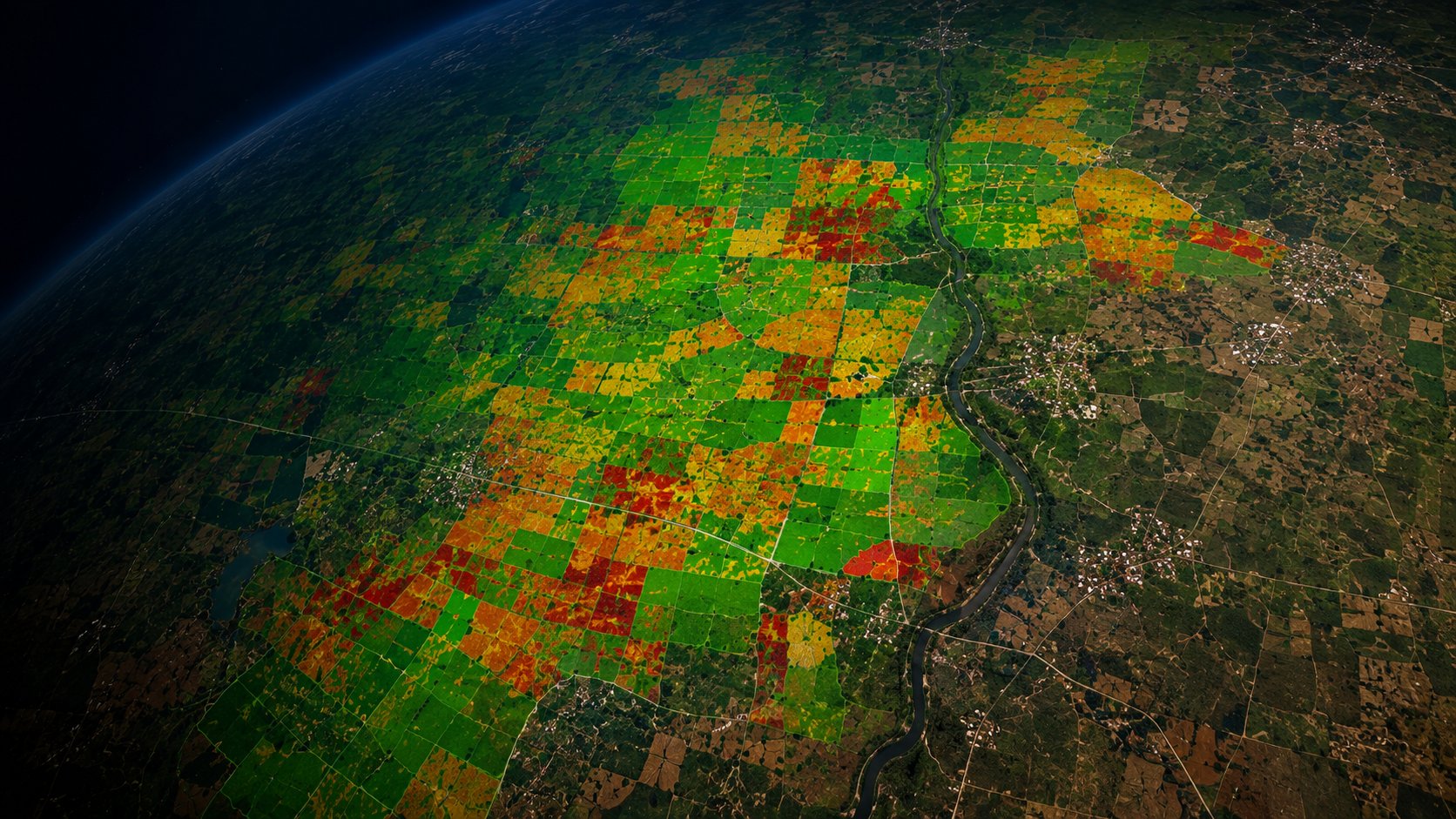
Satellite spectral analysis reveals the true health of farmland — green zones healthy, amber and red zones flagging stress
Why Timing Changes Everything
The economics of agricultural intervention are profoundly non-linear. A modest irrigation adjustment in week two of moisture stress costs almost nothing and preserves the full yield potential. The same intervention in week six — when the stress has become visible — may recover only a fraction of the lost yield, if any. In many cases, the window for effective action has already closed entirely.
This is the calculus that makes satellite intelligence transformative for smallholder farmers. It is not about replacing the farmer's knowledge of their land. It is about extending their perception beyond the limits of human vision, giving them the information they need at the moment it matters most.
Consider the practical difference: a sugarcane farmer in Andhra Pradesh receives an alert that NDMI in the south-western quadrant of her field has dropped below the critical threshold. She increases irrigation to that specific zone. Total cost: negligible. Yield preserved: potentially 15–20% of that quadrant's output. Without that alert, she would have noticed the stress three weeks later — by which point the damage would be irreversible for that growing cycle.
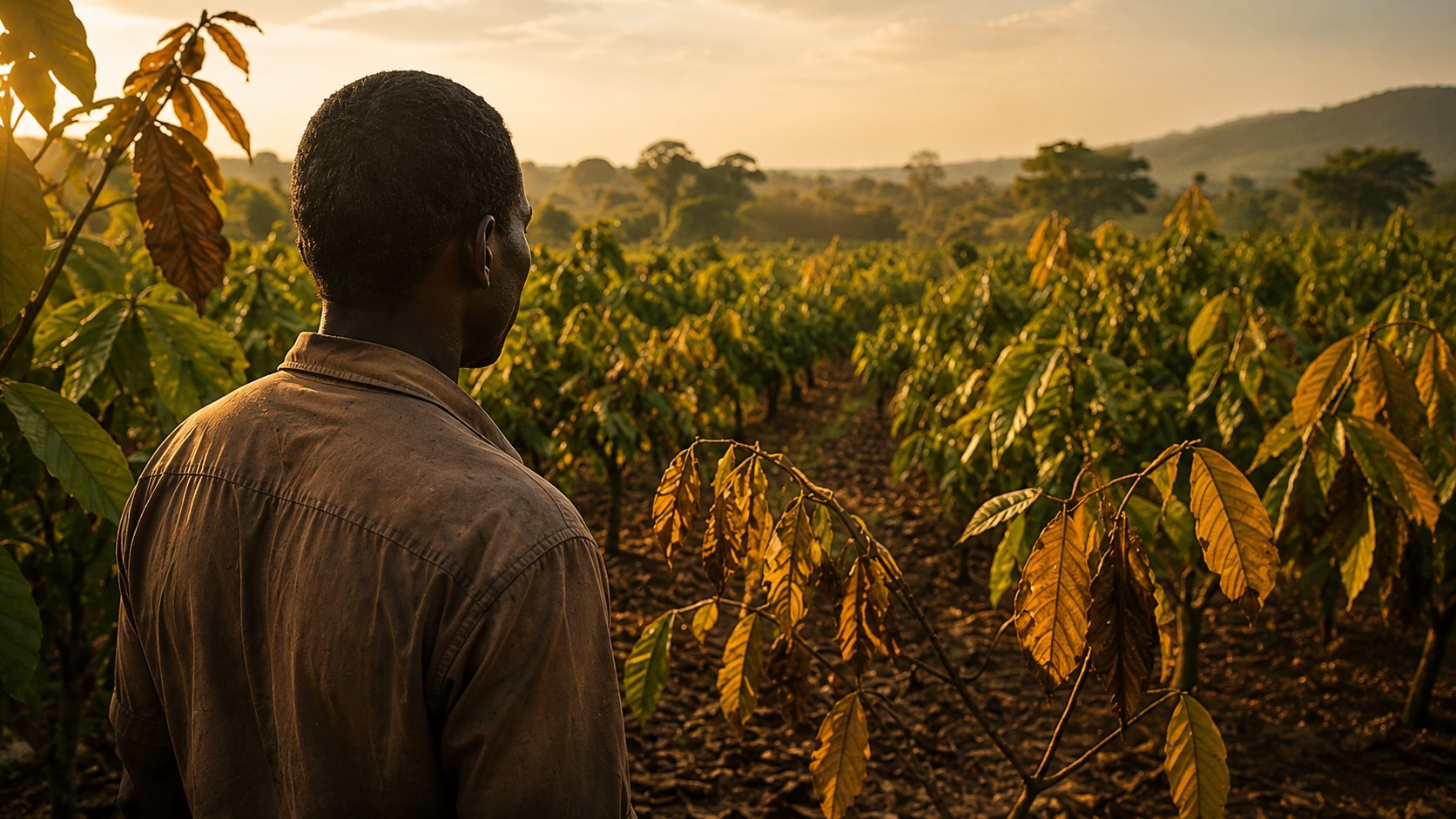
FarmHawk delivers satellite intelligence directly to farmers' smartphones — no hardware required
Built for the Farmers Who Need It Most
We designed FarmHawk from the ground up for the context in which smallholder farmers actually operate. That means no specialised hardware — just a smartphone. No technical training required — reports are delivered in the farmer's own language, with clear plain-language advisories. And no subscription barriers that would exclude the very people who stand to benefit most.
84 crops supported across tropical, subtropical, and temperate varieties
14 languages including Telugu, Hindi, Kannada, Hausa, Yoruba, and Swahili
3 countries live (India, Nigeria, Kenya) with Ghana expansion underway
No drones, no sensors, no hardware to buy or maintain
Every analysis report includes a farm health score, zone-by-zone risk assessment, spectral index visualisations, and actionable recommendations tailored to the specific crop, growth stage, and local conditions. For organic farmers, we provide practice-specific guidance aligned with certification requirements. For farmer cooperatives and agribusinesses, we offer fleet-level monitoring across hundreds or thousands of farms.
The Harvest Gap Is a Timing Gap
Across the Global South, the gap between potential yield and actual yield — what agronomists call the "yield gap" — represents one of the largest untapped opportunities in global food systems. For many crops in many regions, farmers are achieving only 40–60% of what their land is capable of producing. A significant portion of that gap is attributable to late detection of preventable problems.
Satellite intelligence does not close the yield gap on its own. It does not replace good seed, adequate inputs, or sound agronomic practice. But it provides the one thing that has been most conspicuously absent from the smallholder farmer's toolkit: early warning.
Your farm is talking. Every five days, it is broadcasting a detailed report of its health across 13 spectral bands. The question is not whether that data exists. It does. The question is whether it reaches the person who needs it most — and whether it reaches them in time.
Stop guessing. Start knowing.
Visit farmhawk.ai to audit your farm today — your first analysis is free.